The Estimand Framework Explained: ICH E9(R1), Five Attributes, and Intercurrent-Event Strategies

If you design or analyze clinical trials, the estimand framework introduced by the ICH E9(R1) addendum has become part of the everyday vocabulary of protocols, statistical analysis plans, and regulatory interactions. It changed the starting point of trial design: instead of asking “which analysis method should we use?”, teams now ask “what treatment effect are we actually trying to estimate?” — and only then choose the method.
This guide explains what an estimand is, the five attributes that define one, the five strategies for handling intercurrent events, how the choice plays out across therapeutic areas, and how each strategy maps to a concrete analysis in R. The intended reader is a biostatistician, clinical development scientist, or regulatory reviewer who knows trial statistics but wants a precise, working model of the framework.
What is an estimand?
An estimand is the target of estimation — a precise statement of the treatment effect that answers the clinical question of the trial. The ICH E9(R1) addendum defines it as:
> A precise description of the treatment effect reflecting the clinical question posed by a given clinical trial objective.
The crucial point is that an estimand is not an analysis method. It is useful to keep three terms separate:
- The estimand is what you want to estimate (the true treatment effect of interest).
- The estimator is the method used to estimate it (for example, an MMRM or multiple imputation).
- The estimate is the number the estimator produces in your data.
The same estimator can target different estimands, and the same estimand can be approached by different estimators. Run an MMRM on two different definitions of the treatment effect and you get two different conclusions from the same data. That is exactly the ambiguity the framework removes.
| Aspect | Traditional (ITT-centric) thinking | Estimand framework |
|---|---|---|
| Starting point | Choice of analysis set and method | Definition of the treatment effect of interest |
| Intercurrent events | Often handled implicitly or after the fact | Chosen explicitly from five strategies, up front |
| Missing data | Mixed up with treatment discontinuation | Separated cleanly from intercurrent events |
| Sensitivity analysis | An optional add-on | A required check tied to the estimand’s assumptions |
The five attributes of an estimand
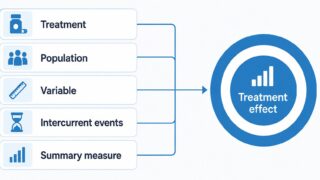
An estimand is specified by five attributes. Leave any one undefined and the “treatment effect” is no longer fully pinned down.
| # | Attribute | What it specifies |
|---|---|---|
| 1 | Treatment | The treatment condition and the comparator — monotherapy or combination, dose, duration, and titration rules |
| 2 | Population | The patients the question is about, defined by inclusion and exclusion criteria |
| 3 | Variable (endpoint) | The measurement obtained from each subject — its definition, timing, and units |
| 4 | Intercurrent events | Post-randomization events that affect interpretation or existence of the endpoint — and the strategy chosen for each |
| 5 | Population-level summary | The summary measure for the between-group comparison (mean difference, odds ratio, hazard ratio, difference in response rates, …) |
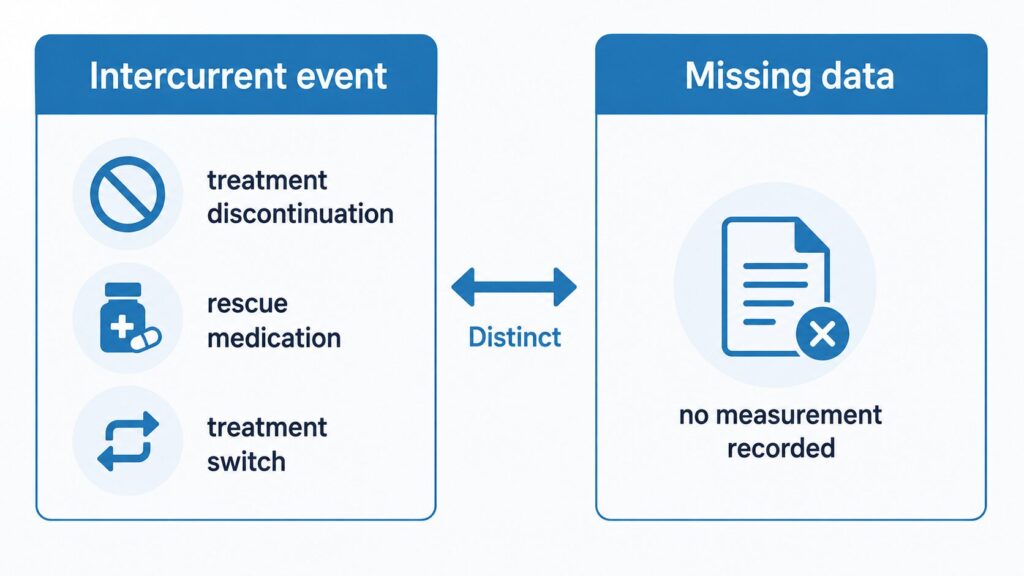
The fourth attribute is where most of the thinking happens. An intercurrent event (ICE) is a post-randomization event — treatment discontinuation, use of rescue medication, a switch to a different therapy, or death — that occurs after treatment starts and changes how (or whether) the endpoint can be interpreted.
An intercurrent event is an event (a patient stops treatment, takes rescue medication). Missing data is a separate, downstream question of whether a measurement exists. A measurement can still be taken after an intercurrent event, and missing data can arise with no intercurrent event at all. Conflating the two leads to the wrong handling strategy and a mis-specified sensitivity analysis.
Five strategies for intercurrent events
ICH E9(R1) sets out five strategies for dealing with intercurrent events. The strategy you choose changes the clinical meaning of the estimated treatment effect — not just the numbers.
| Strategy | How the event is handled | Clinical question it answers | Typical example |
|---|---|---|---|
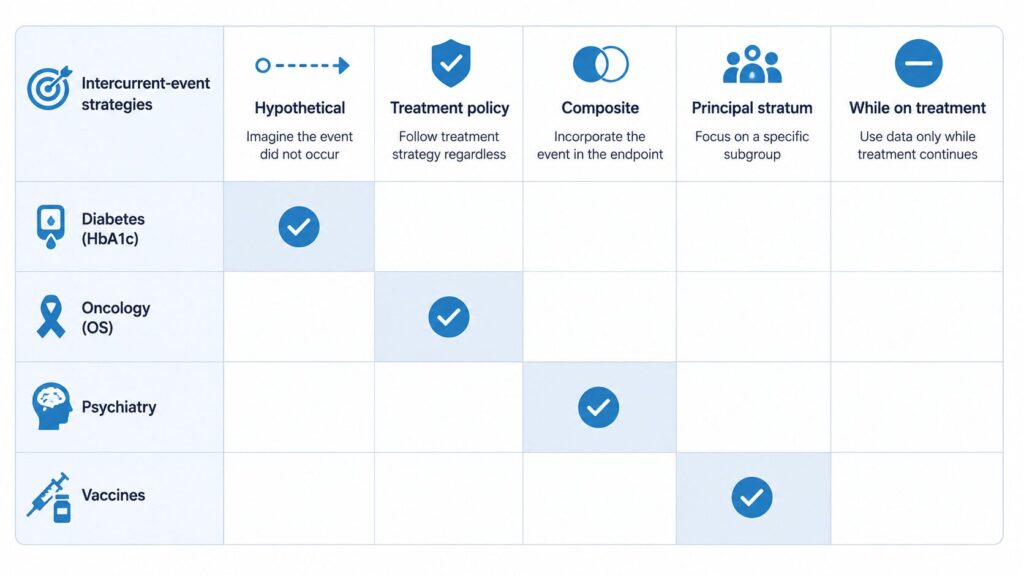
| Treatment policy | The event is treated as irrelevant; the observed outcome is used regardless | What is the effect of being assigned the treatment regimen as it would be used in practice? | Overall survival in oncology |
| Hypothetical | The outcome is the one that would have been observed had the event not occurred | What would the effect have been if the event had not happened? | HbA1c in diabetes, ignoring rescue medication |
| Composite | The event itself is folded into the endpoint (e.g., counted as a failure) | What is the combined success of efficacy and avoiding the event? | “Responder and still on treatment” in psychiatry |
| While on treatment | Only data observed before the event are used | What is the effect during the time patients are actually on treatment? | Symptom or QoL scores in palliative care |
| Principal stratum | The effect is targeted in a latent subgroup defined by event behavior | What is the effect in the subgroup who would not experience the event? | Effect among those who would remain uninfected, in vaccine trials |
You can assign different strategies to different intercurrent events within a single estimand. It is entirely standard to handle “rescue medication” with a hypothetical strategy while handling “death” with a composite or treatment-policy strategy. The estimand is defined by the full set of choices, not a single one.
Choosing a strategy by therapeutic area
Strategy selection is hard to reason about in the abstract, so it helps to anchor it in concrete clinical questions.
Diabetes (HbA1c endpoint)
Patients whose glycemic control deteriorates may be given rescue therapy, and HbA1c measured after rescue no longer reflects the randomized drug. If the question is “what is the intrinsic effect of the study drug?”, a hypothetical strategy (the outcome had rescue not been given) is natural. If the question is “how effective is this as a real-world treatment policy?”, use treatment policy. If it is “what fraction maintained control without needing rescue?”, that is a composite endpoint.
Oncology (overall survival)
Overall survival has death as the event, so measurement continues even after treatment discontinuation or subsequent therapy. A treatment policy strategy is usually the first choice and is generally well accepted by regulators. For progression-free survival, the influence of subsequent therapy is more contentious, and hypothetical strategies are sometimes discussed.
Psychiatry (depression, schizophrenia)
Discontinuation rates are high, and discontinuation mixes “lack of efficacy” with “tolerability”. A naive hypothetical strategy can be misleading here, so composite strategies (“on treatment and improved” counts as success) and while-on-treatment strategies have become more common.
Vaccines and infectious disease
Patients who become infected and are then treated are a different latent group from those who never become infected. To estimate the effect within those who would remain uninfected, a principal stratum strategy is used — but it carries an identifiability problem and therefore demands strong assumptions and explicit sensitivity analysis.
From estimand to analysis in R
Once the estimand is fixed, the strategy for each intercurrent event implies how the data are prepared and which estimator is appropriate. The snippets below are schematic — they show the shape of the analysis for each strategy rather than a single packaged dataset. Assume a long-format data frame long_data with columns subject, arm, visit, change (change from baseline), base (baseline value), and ice_time (the time of the intercurrent event, or NA if none).
Treatment policy keeps everything, including measurements taken after the event, because the event is considered part of the regimen:
library(mmrm)

# Nothing is removed; post-event measurements are retained.
fit_tp <- mmrm(
  change ~ arm * visit + base + us(visit | subject),
  data = long_data
)
Hypothetical treats post-event measurements as missing and targets the outcome that would have occurred without the event. Under a missing-at-random (MAR) assumption, a likelihood-based MMRM estimates this without explicit imputation:
# Drop measurements taken at or after the intercurrent event.
hypo_data <- subset(long_data, is.na(ice_time) | visit < ice_time)

fit_hypo <- mmrm(
  change ~ arm * visit + base + us(visit | subject),
  data = hypo_data
)
This is the strategy most naturally aligned with a default MMRM under MAR; the mechanics of fitting and interpreting that model are covered in our companion guide.
Composite folds the event into the endpoint. Here a “success” requires both a clinical response and no intercurrent event, and the comparison is a difference in success rates:
# One row per subject: responded (0/1) and whether an event occurred.
subj$success <- as.integer(subj$responded == 1 & is.na(subj$ice_time))

tab <- table(subj$arm, subj$success)
prop.test(tab[, "1"], rowSums(tab))   # difference in success proportions
While on treatment restricts each subject to data observed strictly before the event:
on_trt <- subset(long_data, is.na(ice_time) | visit < ice_time)
# then fit the same MMRM on `on_trt`, interpreting the effect as "while on treatment"
Principal stratum cannot be read off the data by simple subsetting, because the latent stratum (for example, “would remain uninfected under either arm”) is not directly observed. It requires structural assumptions and dedicated methods, and should always be paired with a sensitivity analysis.
FAQ
Is the estimand the same as the statistical analysis method?
No. The estimand is the treatment effect you want to estimate; the analysis method (the estimator) is how you estimate it. Two trials can use the same MMRM yet target different estimands, and reach different conclusions. Fix the estimand first, then choose the estimator to match it.
What is the difference between an intercurrent event and missing data?
An intercurrent event is something that happens to the patient (stopping treatment, taking rescue medication). Missing data is whether a measurement was recorded. A measurement can exist after an intercurrent event, and data can be missing without any intercurrent event. The estimand’s intercurrent-event strategy is a design decision; missing data is then handled by the estimator.
Which strategy do regulators prefer?
There is no universally preferred strategy — it depends on the clinical question and the therapeutic area. Treatment policy is common and well accepted for survival endpoints; hypothetical strategies are common for pharmacodynamic endpoints like HbA1c. FDA, EMA, and PMDA can have different expectations for the same disease, so confirm the intended estimand in scientific advice or a pre-submission meeting.
Does the estimand framework make ITT obsolete?
No. The framework refines, rather than replaces, the thinking behind ITT. ITT addresses the analysis population and the principle of analyzing as randomized; the estimand framework makes the rest of the question — especially the handling of intercurrent events — explicit and pre-specified.
Do I need a main estimand and supplementary estimands?
Often, yes. A primary estimand aligned with the regulatory question, paired with one or more supplementary estimands that reflect a different clinical interpretation, tends to communicate the trial’s findings more completely. Each estimand carries its own primary estimator and its own sensitivity analyses.
Further reading
- ICH E9(R1) (2019). Addendum on Estimands and Sensitivity Analysis in Clinical Trials.
- National Research Council (2010). The Prevention and Treatment of Missing Data in Clinical Trials. The National Academies Press.
- Mallinckrodt, C. H. Preventing and Treating Missing Data in Longitudinal Clinical Trials: A Practical Guide. Cambridge University Press.
- A review of the framework’s first years of practical use is a useful complement once the basics are clear.